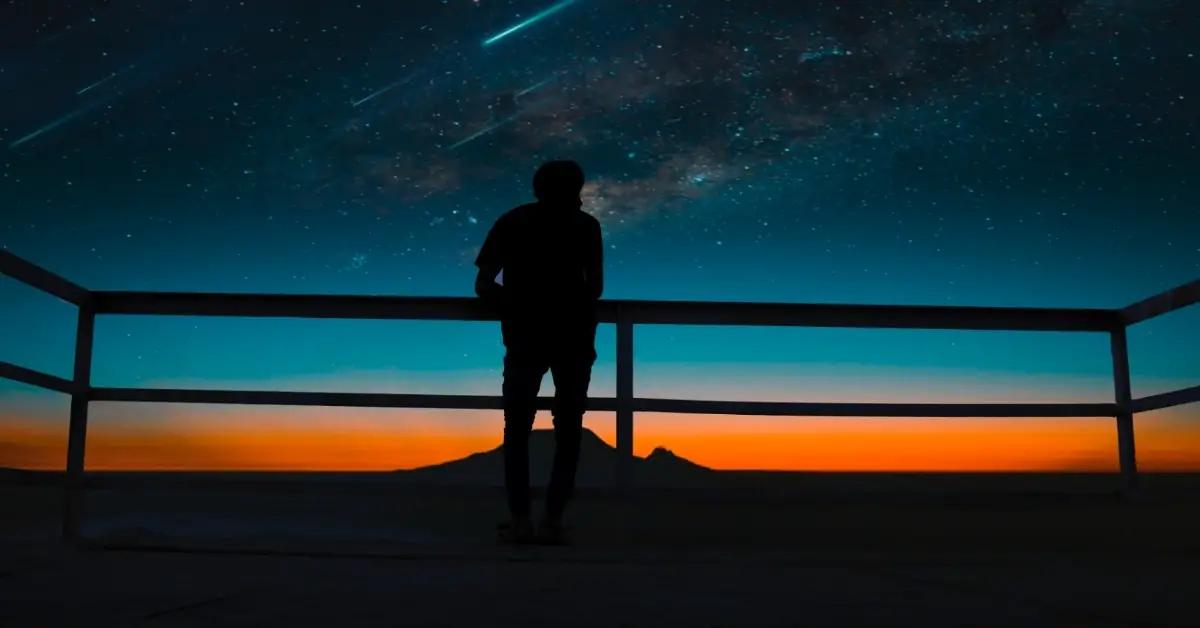
A meteor shower is what happens when Earth, on its yearly path around the Sun, ploughs through a trail of dust and debris left behind by a comet or asteroid. The specks — most no bigger than a grain of sand — slam into our atmosphere at tens of kilometres per second and burn up in a streak of light. We call each streak a meteor, or a shooting star. When many appear to come from the same part of the sky over a night, that's a meteor shower.
Meteor shower meaning, in one line
A meteor shower is a spell of many meteors, all appearing to radiate from one point in the sky, caused by Earth passing through debris shed by a comet or asteroid.
The point they radiate from is called the radiant — it's just a perspective effect, like driving through falling snow and watching it seem to come from one point ahead of you. The radiant is usually named after the constellation it sits in: the Perseids radiant is in Perseus, the Geminids in Gemini, and so on.
Why are meteors so beautiful?
It's a fair question — and a surprisingly common one. A few reasons they move people the way they do:
- They're fast and fleeting. A meteor lasts a fraction of a second to a couple of seconds — you catch it or you miss it. That's part of what makes them feel special.
- They're genuinely ancient. The dust burning up tonight was shed by a comet long ago, sometimes thousands of years before it meets your eye. You're watching the solar system's debris.
- The colours are real. White, yellow, green, even orange or blue — the colour depends on composition and speed. The bright Geminids often glow yellow; faster meteors tend toward green.
- The setting does half the work. Under a truly dark sky a meteor cuts across the Milky Way and thousands of stars — the darkness is what makes it breathtaking. The same meteor over a city goes unnoticed.
Meteor, meteoroid, meteorite — the difference
The three words confuse everyone:
- A meteoroid is the particle while it's still in space.
- A meteor is the streak of light it makes burning up in the atmosphere — the "shooting star."
- A meteorite is the rare piece that survives the journey and lands on the ground.
Most shower meteors are so small they burn up completely. What you see is the glow, not the particle itself.
Famous meteor showers worth knowing
| Shower | Peak month | Notes | |--------|-----------|-------| | Geminids | December | Strongest and most reliable — unusually from an asteroid, not a comet | | Perseids | August | Most famous globally, but falls in India's monsoon | | Eta Aquariids | May | Debris from Halley's Comet; best before dawn | | Lyrids | April | One of the oldest recorded, observed for over 2,000 years | | Quadrantids | January | High rates but very short peak |
For India, the Geminids in December and the Eta Aquariids in May are the ones to plan around — both fall outside the monsoon and are strong enough to be worth a dark-sky trip.
How to watch a meteor shower
No telescope needed — meteors appear all over the sky, so wide-open eyes are best. What you do need:
- A dark location well away from city lights. Light pollution hides all but the brightest meteors.
- The right timing. Rates are highest in the hours after midnight, when your side of Earth is facing into the debris stream head-on.
- Somewhere to lie back and watch a wide patch of sky without craning your neck.
- About 20 minutes for your eyes to fully dark-adapt. Don't use your phone in those first minutes.
A bright Moon washes out faint meteors almost as badly as city glow. Always check the moon phase before you plan a trip — a new-moon night is ideal.
See the next one with us
From inside Mumbai you'll catch only a handful of the brightest meteors. The city's light pollution hides the rest. To see a shower properly — to actually lie back under a Milky Way sky and watch dozens of meteors per hour — you need a dark-sky site.
Infinite.AU runs guided overnight stargazing events at Bhandardara, 165 km (3.5–4 hours) from Mumbai, on new-moon weekends throughout the season (November to May). Our AC bus picks you up in Mumbai (₹2,899), or drive yourself from ₹1,999. Six professional telescopes, astronomy guides, overnight tent stay, dinner and breakfast included.
→ See upcoming events · Current event: Stargazing at Bhandardara, 12 Dec 2026
Also worth reading: our guide to the best stargazing near Mumbai, and if you want to understand why comets and meteor showers are connected, see the comets guide.
Want to see these skies in person? → View our upcoming events