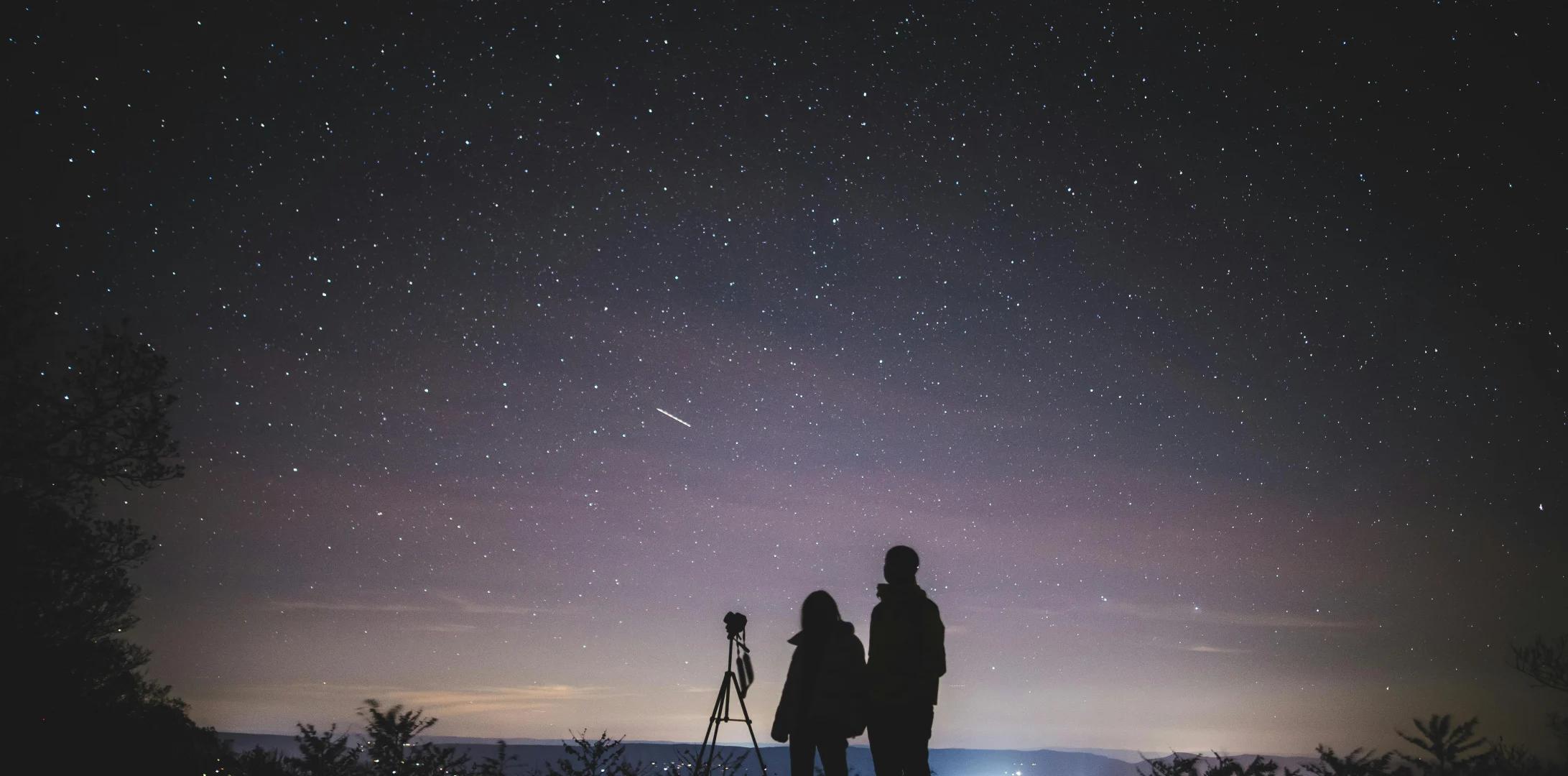
A comet is a small body of ice, dust and rock — often described as a "dirty snowball" — left over from the birth of the solar system. Most spend their lives in the cold outer reaches, but some travel on long orbits that swing them close to the Sun. When one does, the Sun's heat turns its ice to gas, and the comet grows the glowing head and long tail that make it one of the most striking sights in the sky.
Why comets matter
Comets are time capsules from the early solar system. The ice and dust in them has barely changed in over four billion years, so studying comets tells us what the material that formed the planets — and probably delivered some of Earth's water — was actually made of. When space agencies like ESA and NASA send probes to comets, they're essentially taking a sample of the raw ingredients of the solar system.
What does a comet look like in the sky?
The most common misunderstanding: a comet does NOT streak across the sky like a shooting star. A meteor lasts a second; a comet hangs almost still, night after night, moving only slightly against the background stars over days and weeks.
To the eye, a bright comet looks like a fuzzy star with a faint, soft tail pointing away from the Sun. The tail always points away from the Sun regardless of which direction the comet is travelling — it's pushed by the solar wind. Many comets have two tails: a dust tail (curved, white-yellow) and an ion tail (straight, blue-green).
Most comets are faint and need binoculars; only a few per decade become bright enough to see easily with the naked eye. When one does, it can be visible for weeks — something a meteor never manages.
Comet vs. meteor — the quick difference
| | Comet | Meteor (shooting star) | |--|-------|------------------------| | Size | Kilometres across | Grain-of-sand to pea-sized | | Duration | Visible for days to weeks | Lasts 1–2 seconds | | Motion | Barely moves night-to-night | Streaks across the sky instantly | | Brightness | Fuzzy glow, often faint | Brief bright streak | | Cause | Icy body orbiting the Sun | Comet dust burning in atmosphere |
Confusingly, meteor showers are caused by comet dust — when Earth passes through the debris trail a comet left behind. So a comet and its resulting meteor showers are the same object seen two completely different ways. Read more in our guide to meteor showers.
Famous comets worth knowing
Halley's Comet — the most famous of all, returning to the inner solar system approximately every 76 years. Last seen in 1986; next due around 2061. Its debris trail gives us the Eta Aquariid meteor shower each May.
Comet Hale-Bopp — exceptionally bright when it passed in 1997, naked-eye for months and visible even from city suburbs. A once-in-a-generation event.
Comet NEOWISE (2020) — the best naked-eye comet in years. Visible low in the northern sky in July and August 2020, with a distinct dual tail.
Comet 67P/Churyumov–Gerasimenko — the target of ESA's Rosetta mission, the first spacecraft to orbit a comet and deploy a lander onto one.
Is there a comet headed towards Earth?
New comets are discovered regularly, and some pass relatively close — but "close" in space is usually millions of kilometres away. A visible comet is passing by, not heading for us.
When a genuinely bright comet is approaching, it's announced well in advance by organisations like NASA and the International Astronomical Union and becomes a wonderful thing to watch, not a threat. The sky is monitored continuously for Near-Earth Objects, and a hazardous comet would be detected years before any close approach.
Catch the next bright comet with us
When a bright comet appears, a dark sky makes all the difference. From Mumbai's streets you'll see little more than a smudge. But from a dark-sky site, the tail can be stunning — especially in binoculars.
Infinite.AU runs guided overnight stargazing events at Bhandardara, 165 km (3.5–4 hours) from Mumbai. Our astronomy guides point out whatever the sky is offering that night — comets, planets, deep-sky objects, and the Milky Way itself. Events run on new-moon weekends, November through May, with AC bus transport from Mumbai (₹2,899) or self-drive from ₹1,999.
→ See upcoming events · Current event: Stargazing at Bhandardara, 12 Dec 2026
Also worth reading: Best Stargazing Near Mumbai and What Is a Meteor Shower — the two are more connected than most people realise.
Want to see these skies in person? → View our upcoming events