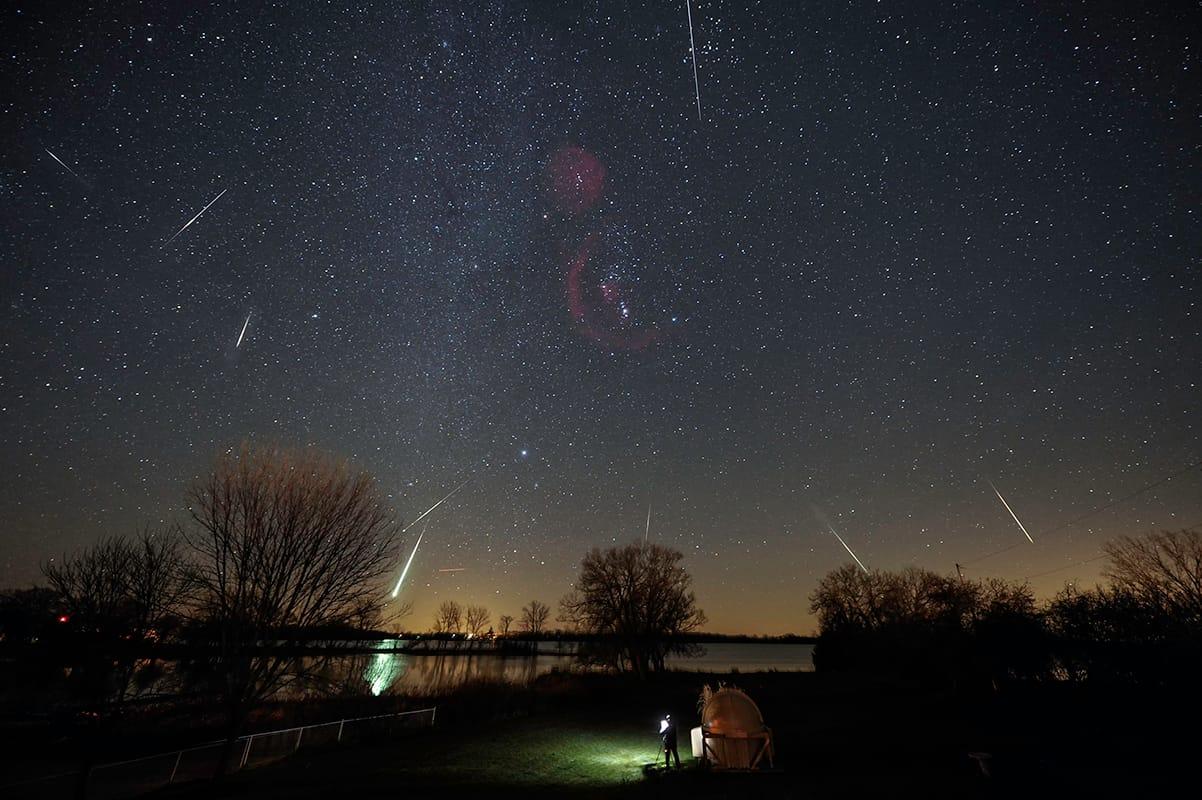
The best place to watch a meteor shower near Mumbai is a dark-sky site a few hours from the city — Bhandardara being the top choice — on a night when a major shower peaks and the moon is out of the way. You can't see meteor showers well from inside Mumbai; city light drowns out all but the very brightest. Below is the meteor shower calendar for the 2026–27 season and how to actually see them.
Why you can't watch from Mumbai
A meteor shower is faint, fast streaks of light across a dark sky. Mumbai's light pollution erases most of them — you might catch one or two bright ones, but you'll miss the show. Even driving 2–3 hours out to a dark site makes an enormous difference. Dark-sky spots like Bhandardara (~165 km away) give you the wide, black sky a meteor shower needs.
Meteor shower calendar 2026–27
These are the major showers visible from near Mumbai during the dark-sky season. Exact peak nights shift slightly each year, and what matters most is catching the peak on a moonless night — so always check the specific date before planning.
| Shower | Typical peak | Notes | |---|---|---| | Leonids | Mid-November (~17–18 Nov) | Fast, bright meteors; moderate rates | | Geminids | Mid-December (~13–14 Dec) | The best shower of the year — bright, plentiful, reliable | | Quadrantids | Early January (~3–4 Jan) | Sharp, short peak; can be intense if timed right | | Lyrids | Late April (~22–23 Apr) | Modest but reliable spring shower | | Eta Aquariids | Early May (~5–6 May) | Debris from Halley's Comet; good pre-dawn rates |
If you only watch one: the Geminids in mid-December. They're the most active and dependable shower of the year, and December's cool, clear skies near Mumbai are ideal.
How to watch a meteor shower (and actually see them)
- Get to a dark site. The darker the sky, the more you'll see. This is the single biggest factor.
- Go near the peak, on a moonless night. A bright moon ruins even a strong shower.
- Let your eyes adapt for 20–30 minutes — no phone screens, use a red-light torch.
- Look slightly away from the radiant, not straight at it, for longer trails.
- Lie back and be patient. No telescope needed — meteors are a naked-eye, whole-sky event.
- Dress warm. Rural sites get cold after midnight, and you'll be still for a long time.
Watch a meteor shower with Infinite.AU
Several of our monthly Date With The Universe events are timed to coincide with major meteor showers at Bhandardara — so you get dark skies, the peak night, telescopes for planets and deep-sky objects between meteors, and astronomers to guide you.
Each overnight camp includes professional telescopes, an astronomy talk, dinner and breakfast, a tent stay, and optional AC bus transport from Mumbai — from ₹1,999.
👉 Check which upcoming events fall on a meteor shower →
Frequently asked questions
Where can I see a meteor shower near Mumbai? At a dark-sky site a few hours from the city — Bhandardara (~165 km) is the best. You cannot see them well from within Mumbai due to light pollution.
When is the next big meteor shower? The Geminids peak in mid-December and are the best of the year. The Leonids come earlier, in mid-November.
Do I need a telescope to see a meteor shower? No — meteor showers are best seen with the naked eye across the whole sky. A telescope is for planets and deep-sky objects.
What's the best meteor shower to watch near Mumbai? The Geminids (mid-December) — the most active, brightest, and most reliable shower of the year.
How do I see the most meteors? Go to a dark site on the peak night when the moon is absent, let your eyes adjust for 20–30 minutes, and look up at the widest patch of open sky.
Catch the next shower under a truly dark sky — see our upcoming stargazing events near Mumbai →
Want to see these skies in person? → View our upcoming events